10 Best Store Leads Alternatives (2026)
Store Leads is genuinely a great product. I’ve been a happy user in other roles/companies. That said, there are many reasons why you might look for an alternative, like:
- Products data isn’t available until the $950 pricing tier
- API access isn’t available until the $250 pricing tier
- It may not have the fields you need for a certain use case
- …etc
So without further ado, here are 10 alternative options.
Last updated: September 2026.
1. Merchant Data
Merchant Data is an India-specific alternative to Store Leads.
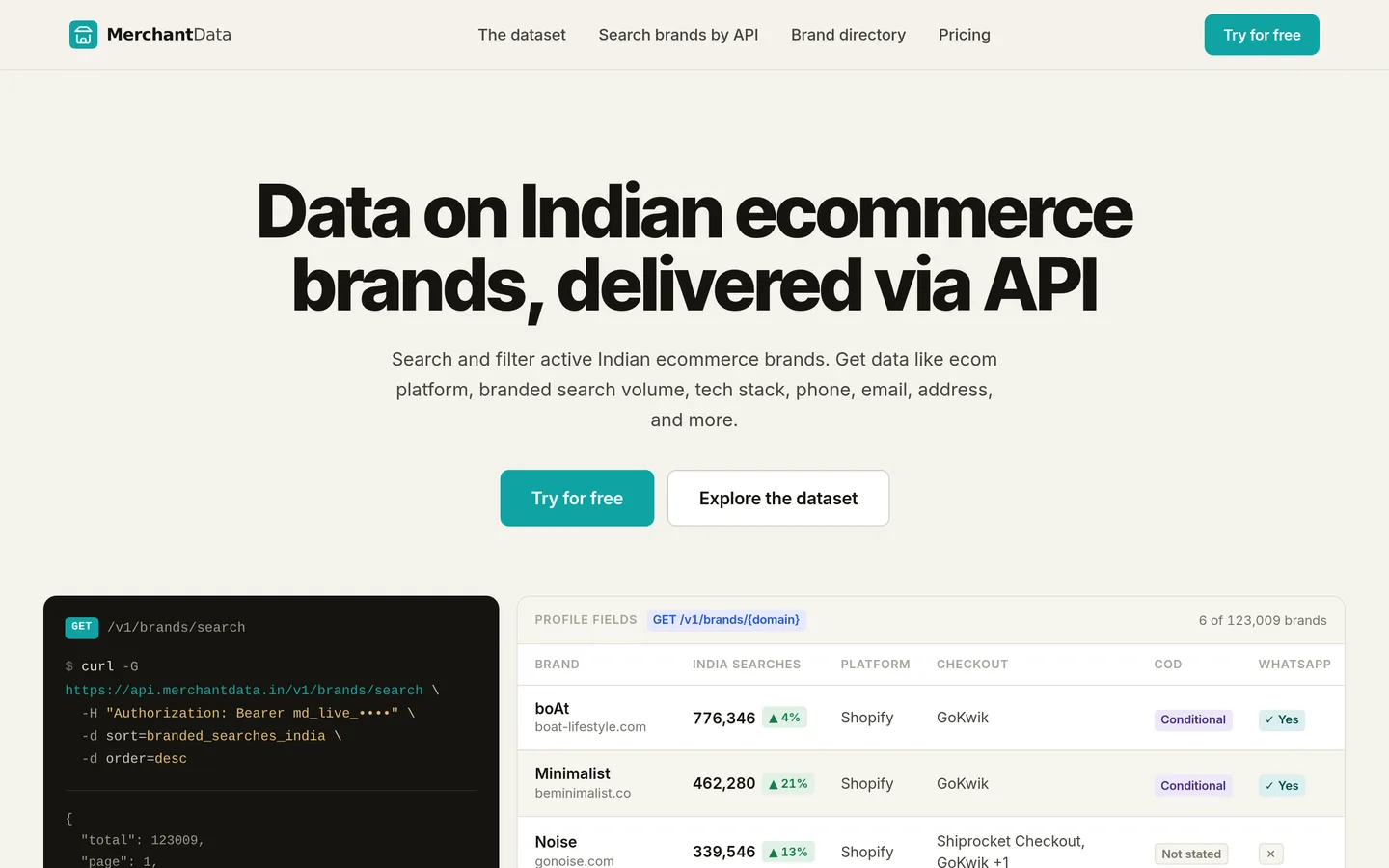
It is an API-only product that lets you:
- Search & filter Indian ecommerce brands by what they sell, their tech stack, etc.
- Get “Brand profiles” that include tech stack, contact details, popularity & more
- Get each brand’s product catalogue (for Shopify & WooCommerce stores)
It is also feasible to use both Merchant Data & Store Leads together. If you already have Store Leads for example, you can bolt Merchant Data onto a waterfall process to improve coverage and depth of Indian brands in your process.
See the documentation here, and visit the homepage here.
Merchant Data vs Store Leads
- Merchant Data offers more India-specific depth than Store Leads. For example, whether or not a brand accepts Cash on Delivery.
- Merchant Data allows pay-as-you-go credit-based pricing, whereas Store Leads is subscription-only.
- Premium features like product catalogues and API access are locked into higher pricing tiers with Store Leads, whereas they are more accessible and affordable in Merchant Data.
- Store Leads has far greater total coverage (global, not only India).
- Store Leads offers some fields that Merchant Data doesn’t, such as estimated employee count.
Merchant Data pricing
Merchant Data pricing is very simple. You either pay per credit ($0.03 per credit) or buy unlimited for $999 per year (works out at ~$83 per month).
2. BuiltWith
BuiltWith is a technology lookup tool for the whole web. It tracks over 127,000 technologies, including ecommerce platforms and Shopify apps, across hundreds of millions of websites.
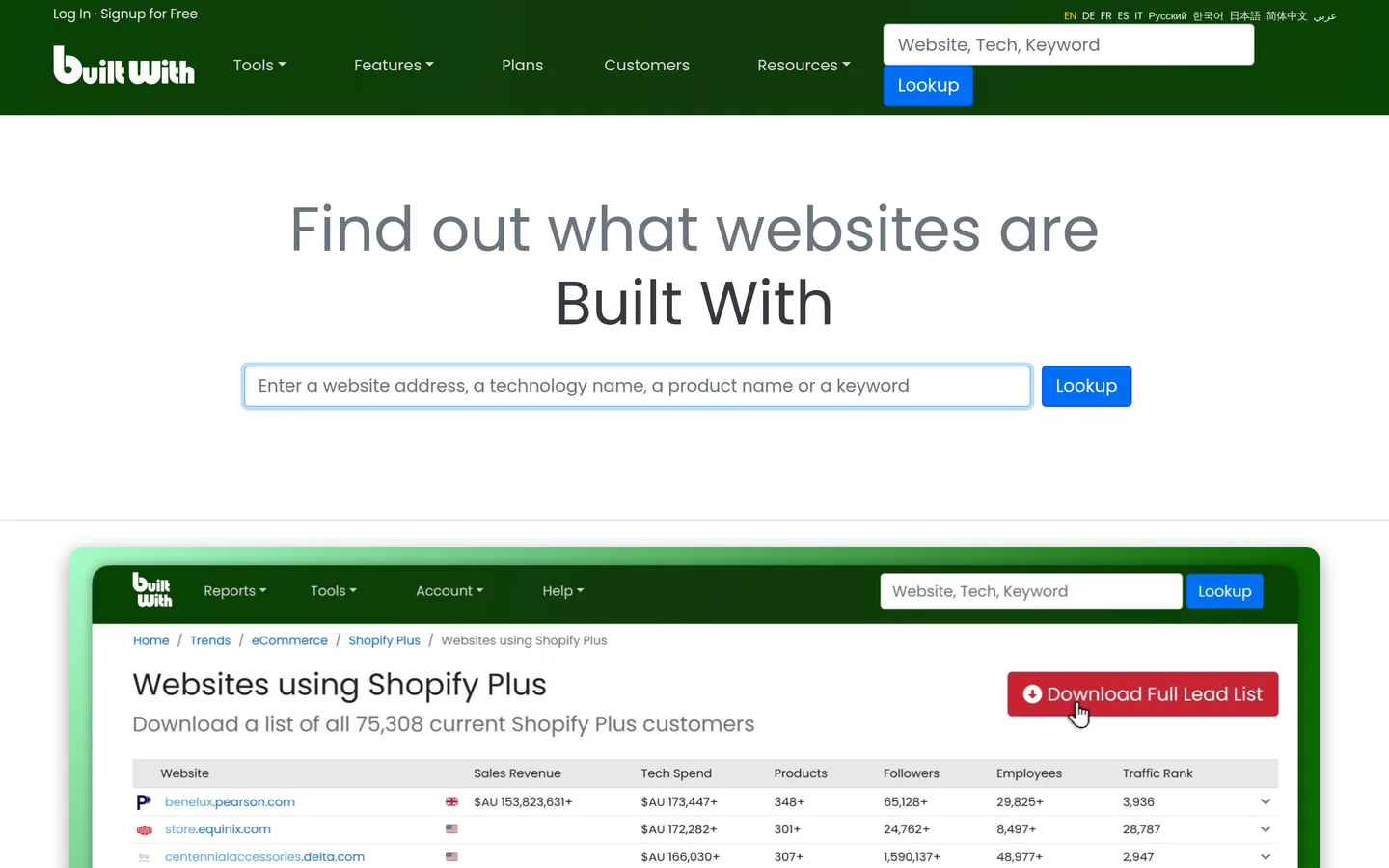
It has a web app and an API, which let you:
- Build lists of websites by the technology they use (e.g. every Shopify store using Klaviyo), filtered by country, estimated revenue, product count etc.
- Look up any website’s full technology profile, including its history
- Export lists with estimated revenue, product count, contact names & emails, and sync them to your CRM
Ecommerce is a big part of it: BuiltWith says it tracks over 26 million ecommerce websites and 2,500 ecommerce technologies.
See the documentation here, and visit the homepage here.
BuiltWith vs Store Leads
- BuiltWith covers every kind of website, not only online stores, so it also answers questions outside ecommerce. Store Leads is built only for ecommerce.
- Every BuiltWith paid plan includes contact names & emails, revenue estimates, history and API credits. With Store Leads, contact data comes through its Apollo.io and ContactOut integrations, and historical data is on the Enterprise plan.
- Store Leads is cheaper to start ($75 per month, against $295 for BuiltWith), and its $250 plan includes exports and the API. BuiltWith’s $295 plan allows 2 technology lists per month.
BuiltWith pricing
BuiltWith is free for looking up one website at a time. Paid plans are $295 per month (Basic, 2 technology lists a month), $495 per month (Pro, unlimited lists) and $995 per month (Team, unlimited users). Paying yearly costs 10 times the monthly price, about 17% less. API credits can also be bought on their own, at $99 for 2,000 lookups.
3. StoreCensus
StoreCensus is a database of Shopify and WooCommerce stores, built for lead generation. It is the closest like-for-like alternative in this list, and tracks 4.8 million stores, updated weekly.
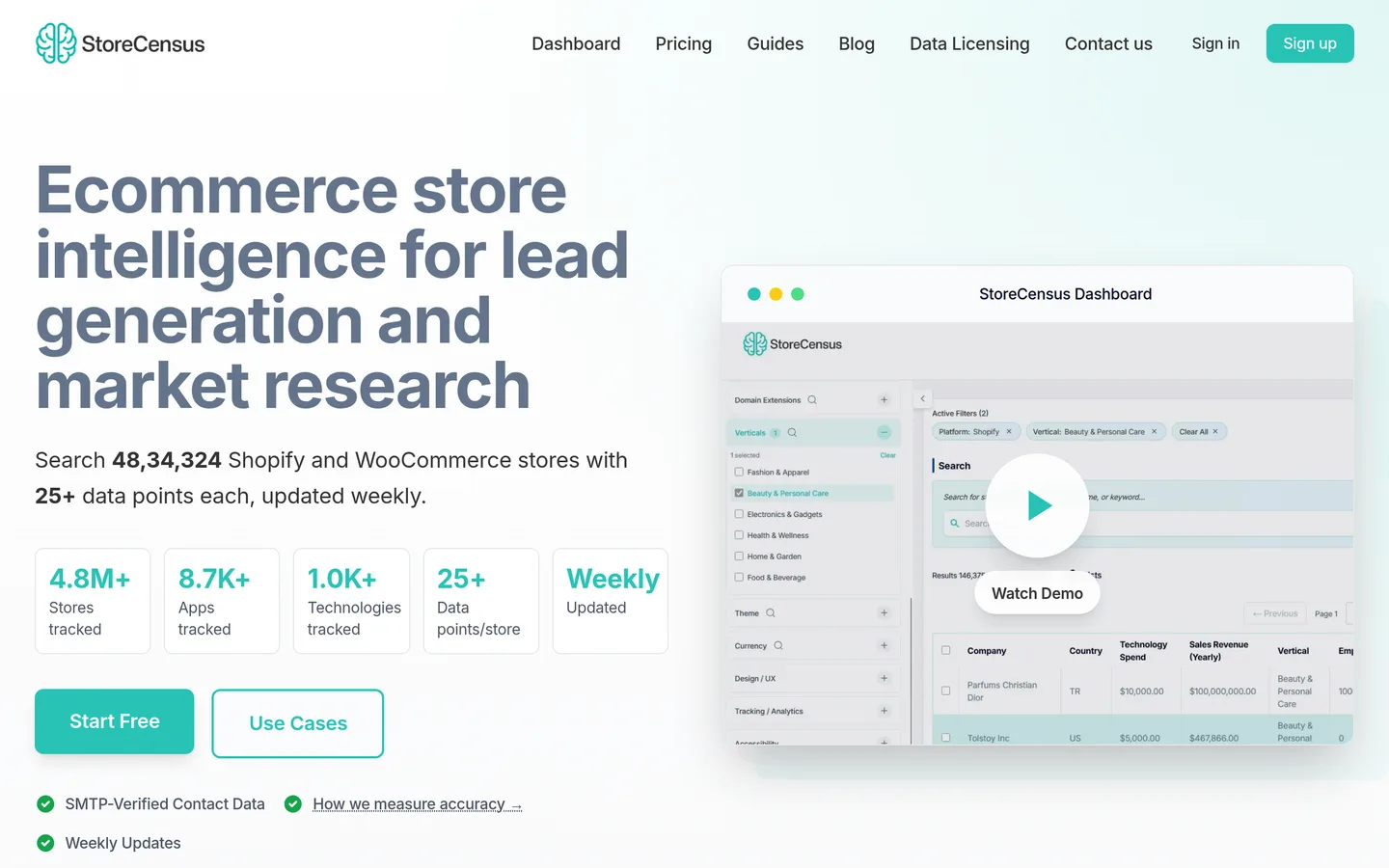
It has a web app and an API, which let you:
- Search & filter stores by installed apps, theme, country, estimated sales, estimated traffic etc.
- Unlock verified store emails and decision-maker contacts (founders, marketing leads etc.)
- Push leads to Apollo.io, Instantly, Smartlead or any tool via Zapier, and get alerts when a store changes
Each store record also carries its Shopify plan, theme, product count and average product price, and you can filter by growth or by when an app was installed or removed.
See the documentation here, and visit the homepage here.
StoreCensus vs Store Leads
- StoreCensus is cheaper. Paid plans start at $49 per month with CSV exports, and API access starts at $99 per month. Store Leads’ exports and API start at $250 per month.
- StoreCensus includes contact details in the product (verified store emails and decision-maker contacts, paid for with credits). Store Leads gets contact data through its Apollo.io and ContactOut integrations.
- Store Leads covers far more: 409 ecommerce platforms and 13.8 million active stores, against Shopify & WooCommerce and 4.8 million stores.
- Store Leads has product data (1.8 billion products, with product search on Enterprise), native CRM integrations and a Chrome extension. StoreCensus gives product counts & average price per store, and connects to CRMs through Zapier.
StoreCensus pricing
StoreCensus has a free plan for testing. Paid plans are $49 per month (Starter, Shopify only), $99 per month (Professional, adds WooCommerce, contacts and the API) and $149 per month (Growth, adds search and bulk exports through the API). Each plan includes monthly credits for unlocking contacts, and extra credits cost $8 per 1,000.
4. Wappalyzer
Wappalyzer started as a browser extension that shows which technologies a website uses. It now also builds prospect lists by technology, with data from millions of websites.
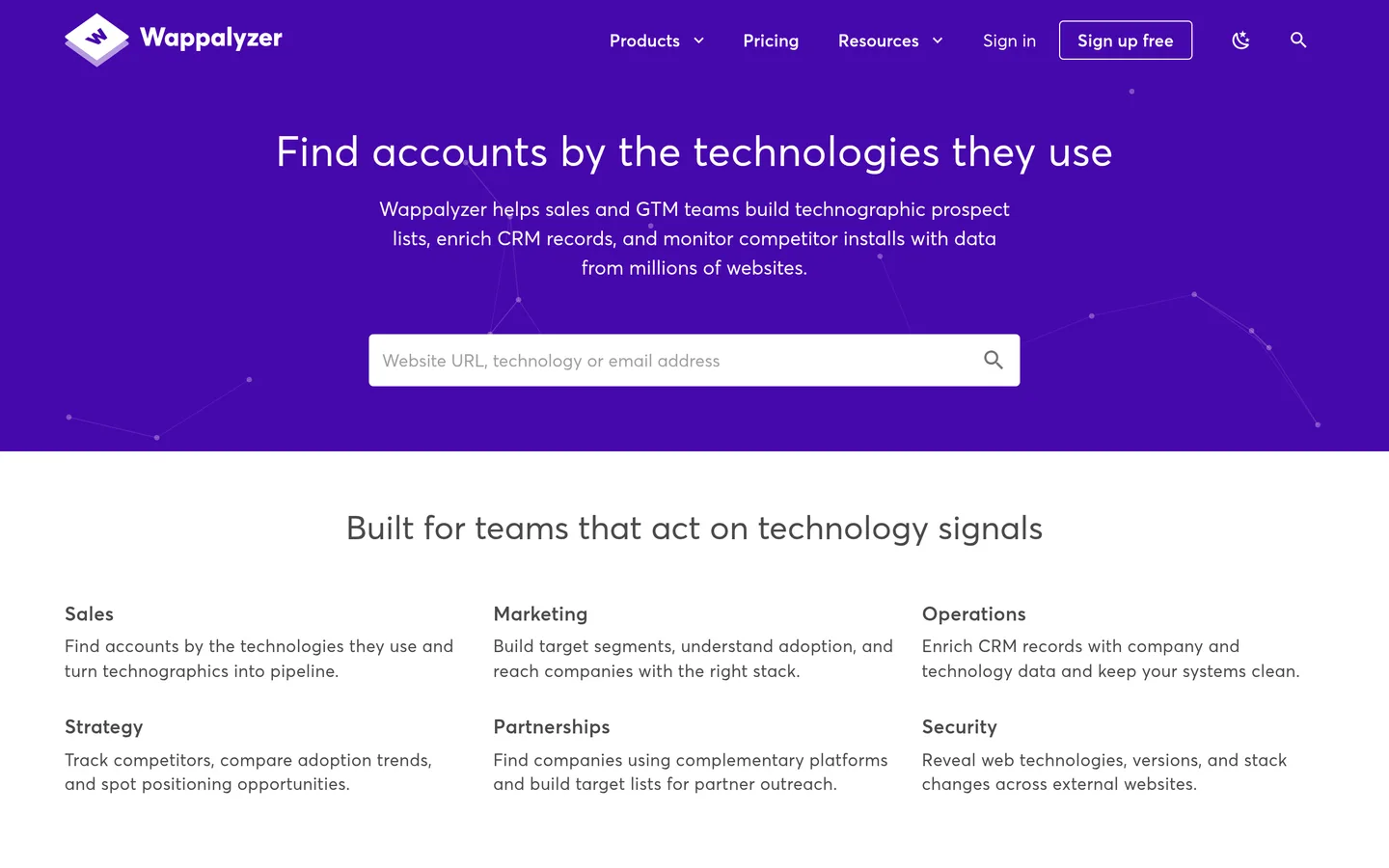
It has a web app, browser extensions and an API, which let you:
- Build lead lists of websites by technology (e.g. Shopify, or a Shopify app), filtered by country, industry, company size, traffic etc.
- Look up the technologies behind any website, one at a time or in bulk
- Enrich your CRM with technology, company & contact details, and get alerts when a website’s tech changes
It tracks 8,125 technologies across 106 categories, including 766 ecommerce technologies.
See the documentation here, and visit the homepage here.
Wappalyzer vs Store Leads
- Wappalyzer has cheaper ways in: a free plan with 50 lookups a month, and a $10 per month plan for researching one website at a time. Store Leads starts at $75 per month.
- Wappalyzer covers every kind of website, not only stores. Store Leads is built for ecommerce, with 8,291 apps tracked (Wappalyzer’s directory lists 178 Shopify apps) and product data.
- Store Leads has estimated sales and visits for each store. Wappalyzer gives a relative traffic level (e.g. low, medium, high) and no revenue estimate.
- Wappalyzer’s API starts on its $450 per month plan, Store Leads’ on its $250 per month plan.
Wappalyzer pricing
Wappalyzer has a free plan (50 lookups a month) and a $10 per month plan for single lookups. Lead lists start at $250 per month (Pro, 2 technologies a month), the API and CRM enrichment at $450 per month (Business), and Enterprise at $850+ per month. Paying yearly saves 17%.
5. Similarweb
Similarweb is a digital data company best known for estimating website traffic. Its Sales Intelligence product is built for teams selling to online businesses, with traffic, technology and contact data on each company.
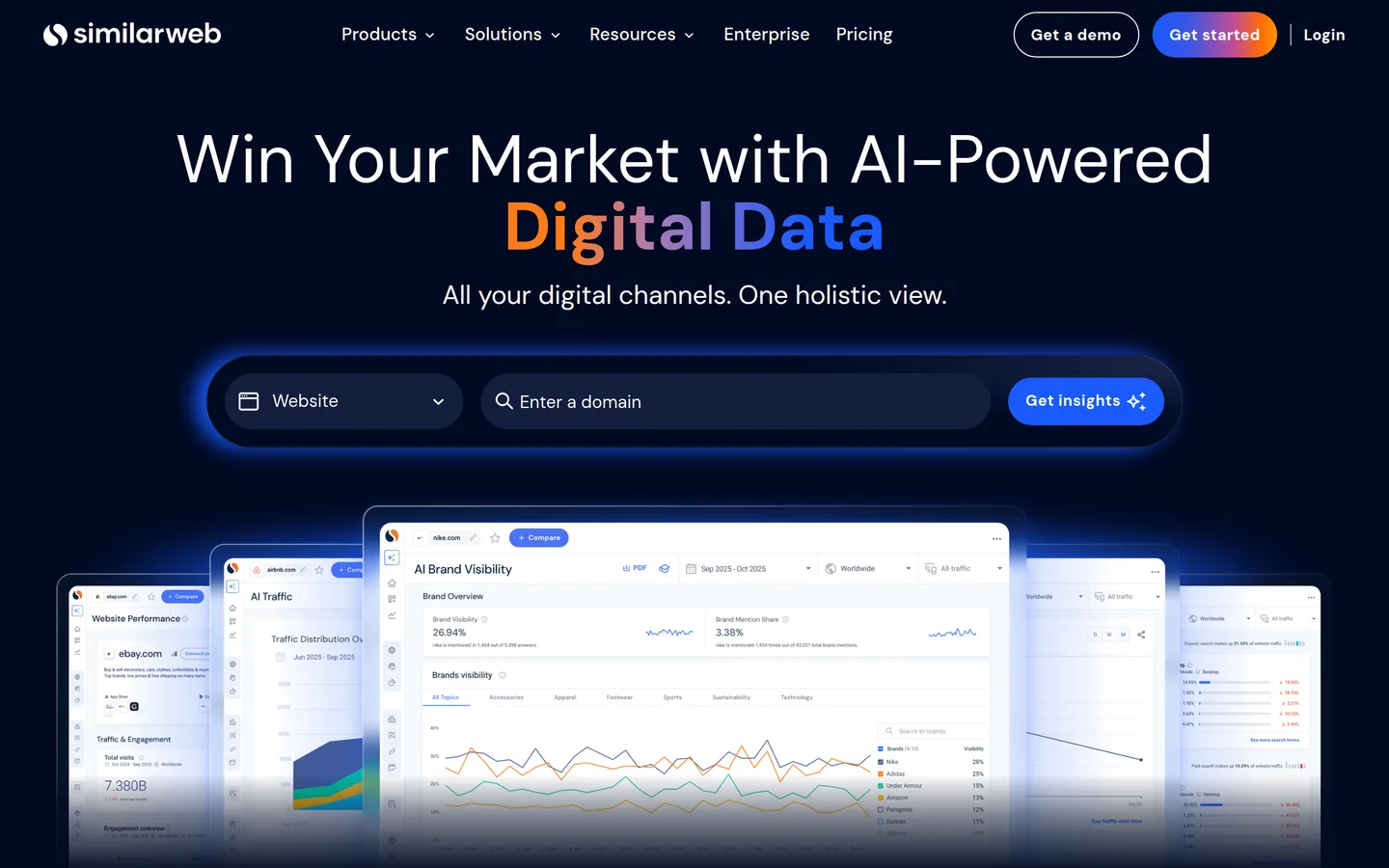
It has a web app, a Chrome extension and an API, which let you:
- See traffic estimates for any website: monthly visits, where visitors come from, marketing channels etc.
- Build lead lists of ecommerce companies with 50+ filters, including traffic growth, online revenue, ecommerce platform and payment options
- Get contact details (emails & direct phone numbers) and export them to a CSV, Salesforce or HubSpot
Its free website shows headline traffic figures for a website, as a sample of the paid data.
See the documentation here, and visit the homepage here.
Similarweb vs Store Leads
- Similarweb’s traffic data goes much deeper: visits, unique visitors, marketing channels and visitor geography, with years of history. Store Leads gives one estimated visits figure and one page views figure per store.
- Similarweb includes contact details in Sales Intelligence. Store Leads gets contact data through its Apollo.io and ContactOut integrations.
- Store Leads is built around online stores, with 13.8 million active stores, 8,291 apps and 1.8 billion products. Similarweb covers over 100 million websites, but doesn’t publish a count of stores, apps or products for independent stores.
- Store Leads publishes the price of every plan, including API access ($250 per month). Similarweb’s API and CRM integrations are on plans priced through its sales team.
Similarweb pricing
Similarweb sells each product separately. Sales Intelligence starts at $99 per month billed yearly ($129 paid monthly) for 1 user and 1,000 data credits, with CSV export but no API. The Business and Enterprise plans, which include the API and CRM integrations, are priced on request. Web Intelligence (traffic research) costs $125 to $542 per month billed yearly. There is a 7-day free trial.
6. Apollo.io
Apollo.io is a sales platform built on a database of 240 million contacts and 30 million companies. Where Store Leads is organised around online stores, Apollo is organised around companies and the people who work at them.
It has a web app, a Chrome extension and an API, which let you:
- Search companies & people with 65+ filters, including location, industry, headcount, revenue and technologies used (e.g. Shopify, Klaviyo)
- Get verified emails & phone numbers for decision makers
- Run outreach from the same tool: email sequences, a dialer and CRM sync
Many teams use it next to a store database, and Store Leads itself has an Apollo.io integration for contact data.
See the documentation here, and visit the homepage here.
Apollo.io vs Store Leads
- Apollo is far stronger on people: names, job titles, emails & phone numbers. Store Leads connects to Apollo.io and ContactOut for people data, so the two are often used together.
- Store Leads has the ecommerce detail that Apollo doesn’t: ecommerce platform, installed apps, products and estimated sales for 13.8 million active stores. In Apollo, technology is one of 65+ filters, and its 30 million companies are not limited to online stores.
- Apollo is cheaper to start, with a free plan that includes API access and paid plans from $49 per user per month. Store Leads’ API starts at $250 per month.
- Apollo charges per user, plus credits for contact details. Store Leads charges per plan, with 1 to 10 users included.
Apollo.io pricing
Apollo.io has a free plan (75 credits per user per month). Paid plans are $49, $79 or $119 per user per month billed yearly (Basic, Professional, Organization), or $65 and $99 paid monthly for the first two. Credits pay for contact details: an email costs 1 credit and a mobile number 8. Its standard plans are for internal use only, so reselling the data or building a product on it needs a separate agreement.
7. Clay
Clay is a platform for combining data from many providers in one spreadsheet-like table. It isn’t a store database itself: it connects to 150+ data providers, and Store Leads is one of them.
It has a web app and an API, which let you:
- Pull store data from several sources into one table, e.g. Store Leads, BuiltWith and Similarweb side by side
- Run “waterfalls” that try providers in order until one returns an email, a phone number or any other field
- Use Claygent, its AI web researcher, to pull custom data points from each store’s website
So Clay is less a replacement for Store Leads than a way to use it next to other sources. You can connect your own Store Leads account, or pay for lookups with Clay’s credits.
See the documentation here, and visit the homepage here.
Clay vs Store Leads
- Clay combines many providers, so one table can hold store data, contacts and your own research. Store Leads is a single database.
- Store Leads is the source here: Clay’s Store Leads actions return Store Leads’ own data. If Store Leads is the only source you need, going to it directly is simpler.
- Store Leads has a flat monthly price. In Clay every lookup uses credits, so the cost grows with the number of rows you process.
Clay pricing
Clay has a free plan (500 actions and 100 data credits a month). Paid plans are $185 per month (Launch) and $495 per month (Growth), or $167 and $446 per month billed yearly, and Enterprise is priced on request. Actions pay for running the table, and data credits pay for data from providers, from $0.05 per credit. There is a 14-day free trial.
8. PublicWWW
PublicWWW is a search engine for website source code. Instead of a database of stores, it lets you search the HTML, JavaScript and CSS of over 900 million web pages for any snippet of code.
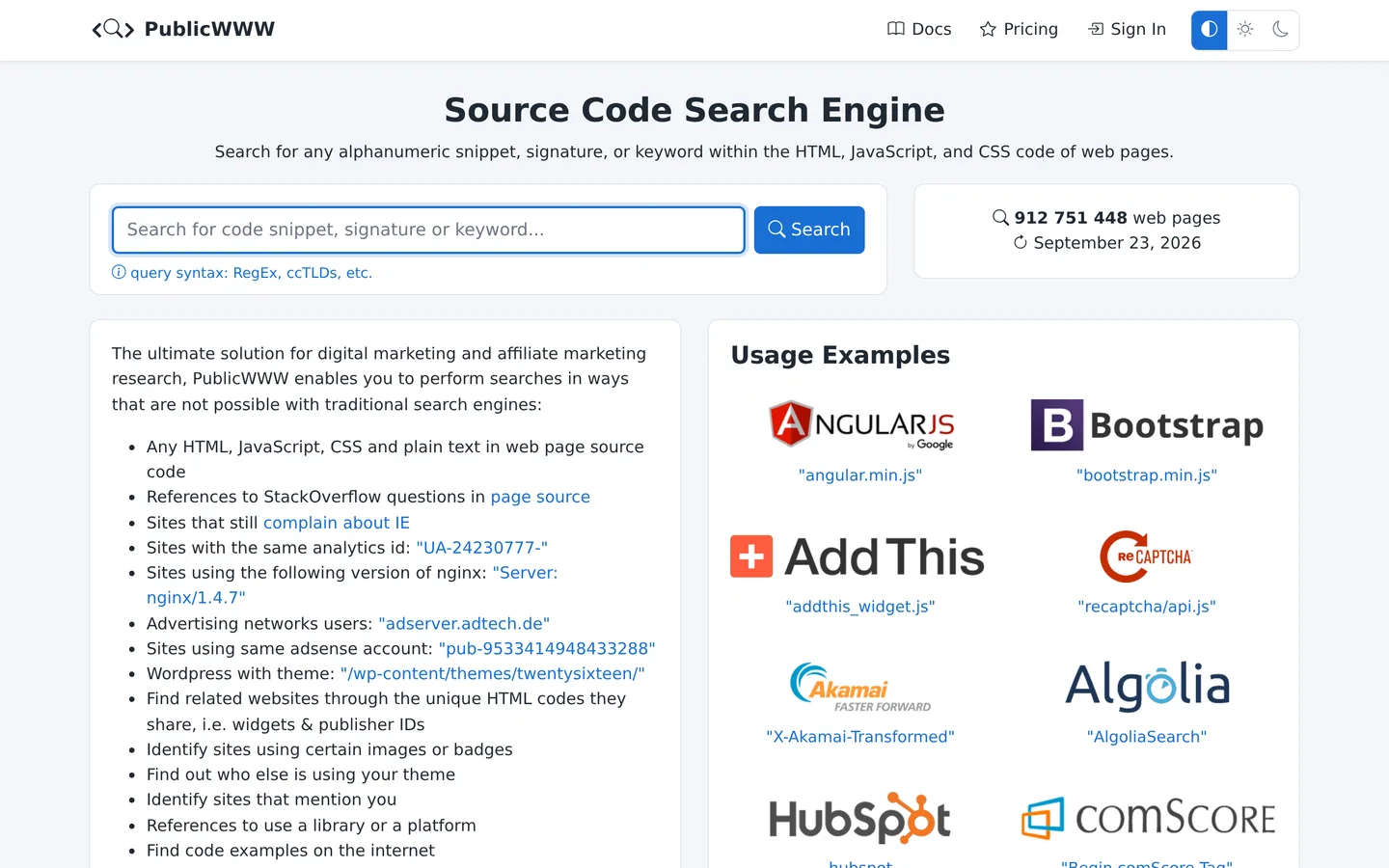
It is a search tool (with an API on paid plans) that lets you:
- Find every website whose code contains a given snippet, like cdn.shopify.com or a specific app’s script
- Narrow results by domain ending (e.g. only .de sites), and search inner pages, not only homepages
- Download results as a CSV, and pull emails & phone numbers out of the sites you found
It suits searches that no store database covers yet, like finding every store that uses a brand new app or a particular theme.
See the documentation here, and visit the homepage here.
PublicWWW vs Store Leads
- PublicWWW can find any piece of code, including apps & scripts that Store Leads doesn’t track. Store Leads tracks a set list of 8,291 apps and 1,003 technologies.
- Store Leads gives you a database of stores with the platform, apps, estimated sales and more already attached. PublicWWW gives you a list of URLs ranked by popularity, so working out which results are stores (and on which platform) is up to you.
- PublicWWW’s only country filter is the domain ending (e.g. .de), so it misses stores in that country that use a .com address. Store Leads records each store’s country.
- PublicWWW’s API is included in every paid plan, from $109 per month. Store Leads’ API starts on its $250 per month plan.
PublicWWW pricing
PublicWWW has a free plan that covers the top 3 million websites, with up to 1,000 results per search. Paid plans are $109, $199 or $499 per month ($1,090, $1,990 or $4,990 per year), and all three include the API. You can also buy a single day for $49 or a week for $79.
9. ECDB
ECDB is an ecommerce market research platform, founded in 2022 by the founders of Statista (it used to be ecommercedb.com). It focuses on how much online stores sell, with revenue estimates built from card & payment transaction data.
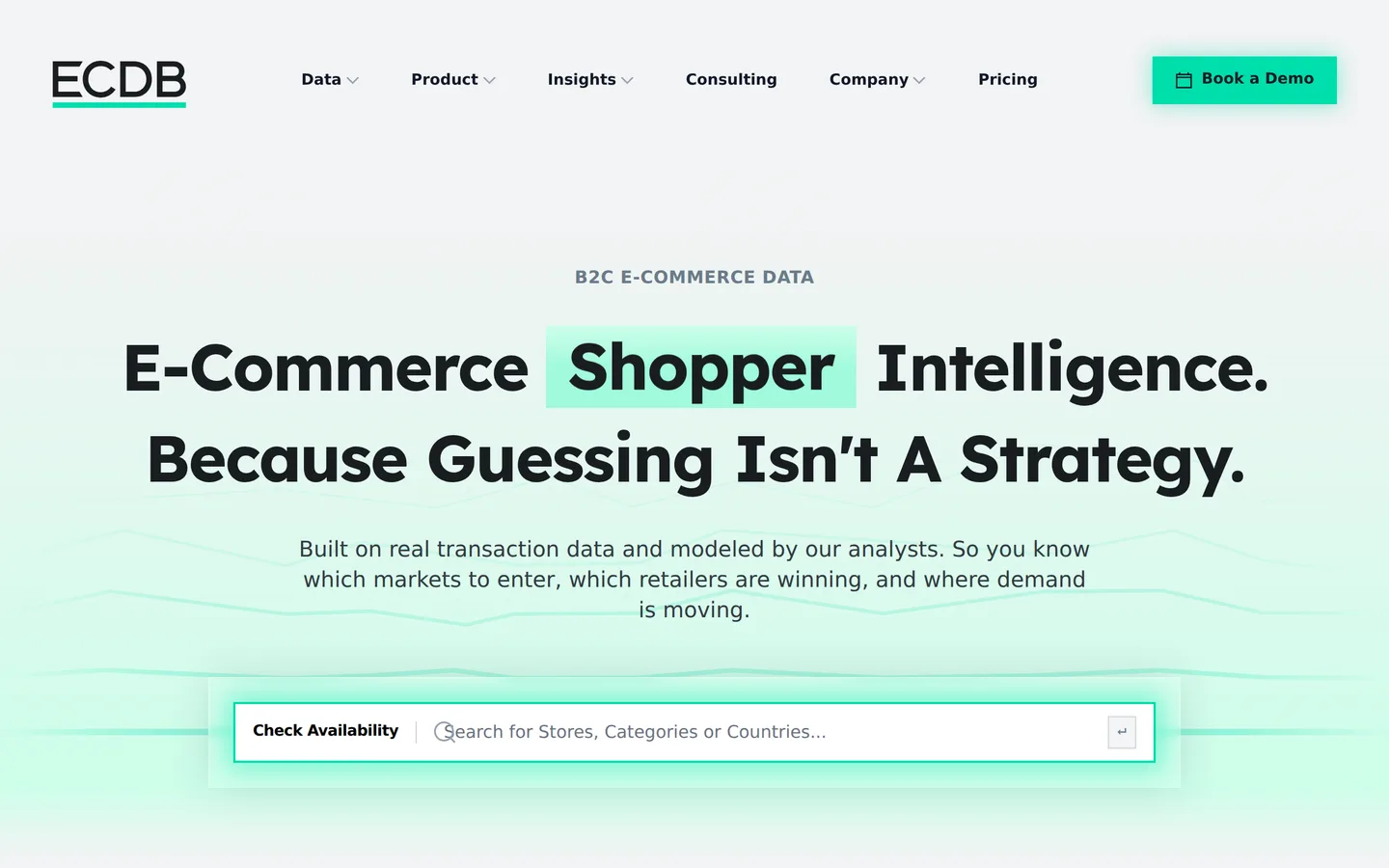
It is a web app (with an API on higher plans) that lets you:
- Look up revenue estimates for online stores, plus conversion rate, average order value and category split
- Rank stores by country, category, revenue, payment provider or shipping provider
- Get market size data by country & category
It covers tens of thousands of retailers, and the data is updated monthly.
See the API page here, and visit the homepage here.
ECDB vs Store Leads
- Both estimate how much a store sells. ECDB builds its estimates from card & payment transaction data and adds more detail per store (monthly revenue, conversion rate, average order value, category split). Store Leads gives one estimated monthly sales figure per store.
- Store Leads covers far more stores (13.8 million active stores, against ECDB’s tens of thousands of retailers), and detects each store’s platform, apps & technologies.
- ECDB has market size data by country and category. Store Leads is focused on individual stores.
- Store Leads updates weekly, ECDB monthly.
- Store Leads can be paid monthly and starts at $75 per month. ECDB is billed yearly and starts at $433 per month.
ECDB pricing
ECDB is billed yearly. Plans start at $433 per month (Essential, 1 user, no API), then $810 per month (Business, 3 users, API included) and $1,125 per month (Enterprise, 5 users). Visitors outside North America see the prices in euros: €375, €675 and €975 per month. Add-ons, like Lead Finder for contact details, are priced on request.
10. Tracxn
Tracxn is a private market data platform. It tracks over 7.7 million companies worldwide, with a focus on who funded them and what they are worth.
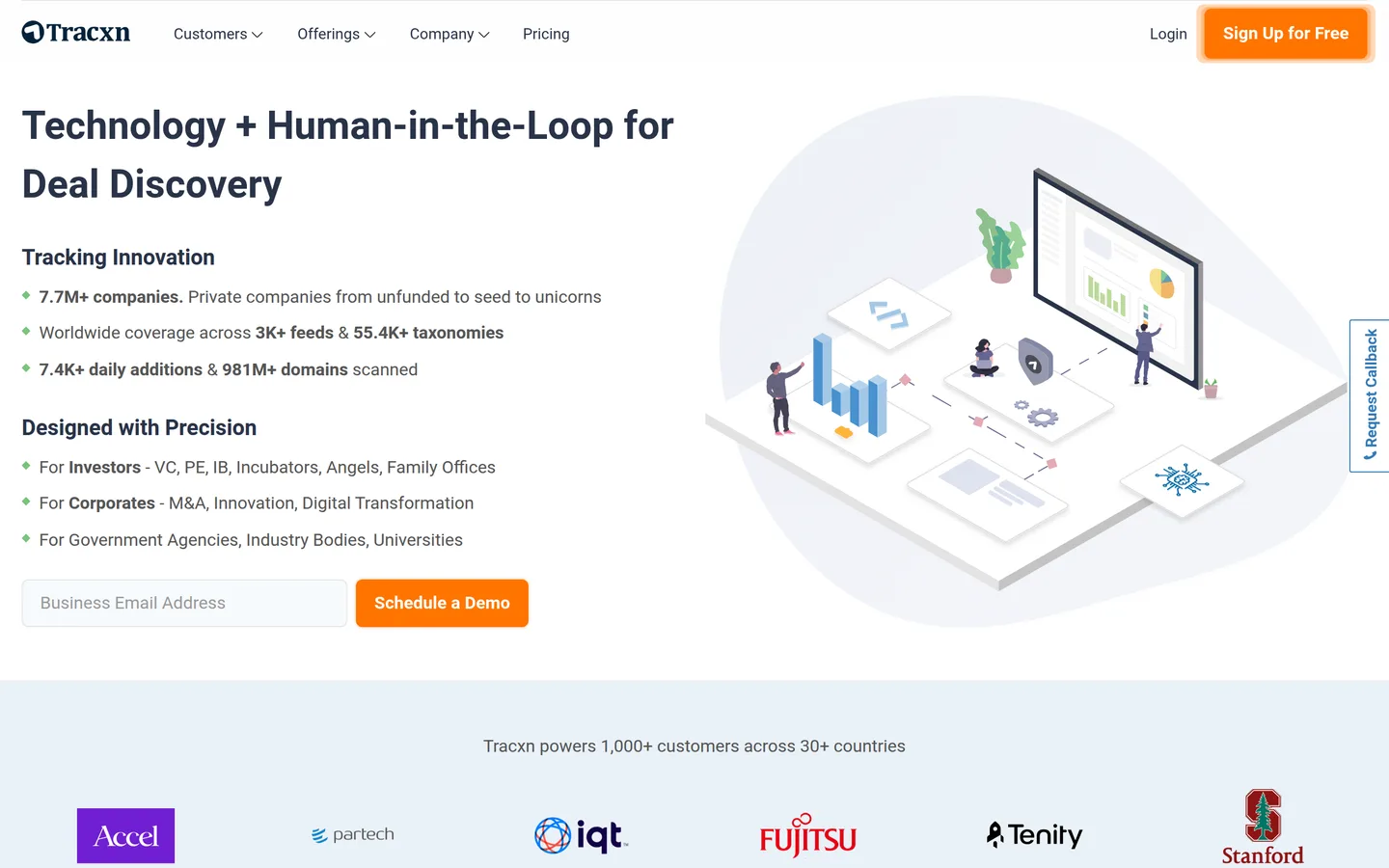
It is a web app (with an API as an add-on) that lets you:
- Search & filter companies by sector, country, funding stage, investors etc.
- Get company profiles with funding rounds, valuations, financials & competitors
- Follow sector feeds, including D2C business models like D2C Apparel Brands, D2C Beauty Brands and D2C Food Brands
Its sector feeds include consumer brands: the D2C Apparel Brands feed alone lists 4,180 companies.
See the API page here, and visit the homepage here.
Tracxn vs Store Leads
- Tracxn has funding, investor, valuation & financials data, which Store Leads doesn’t.
- Store Leads has storefront data that Tracxn doesn’t: the ecommerce platform, installed apps, technologies and products.
- They look at a brand from different angles. Tracxn describes it as a company (who funded it, what it is worth), Store Leads as a website (what it runs, what it sells).
- Store Leads publishes its prices and sells API access self-serve. Tracxn’s paid plan and API are priced through its sales team.
Tracxn pricing
Tracxn has a free Lite plan for non-commercial use, with usage limits and 200 export credits a month. The paid Premium plan and the API packs are priced on request, and no prices are published.